Read The Tsar's Dwarf (Hawthorne Books)

Read The Tsar's Dwarf (Hawthorne Books)
"A curious and wonderful work of great human value by a Danish master." Sebastian Barry, Man Booker finalist (Click on the picture to go to the book's Amazon page)

Thursday, April 23, 2015

The Three Days With Sam Shepard That Changed My Writing Life


1.
It happened on a hot day in the beginning of the Eighties.

Everybody was sitting at a long table waiting for the Master. And it wasn't just young students like me. It was professional actors and writers from Hollywood who were going to work on His play at the Padua Hills Playwriting Workshop outside L.A.

Sam Shepard entered. He was tall and shy and threw himself into a chair. He wasn't much known as an actor back then but as a poet and playwright who'd just won the Pulitzer Prize for Buried Child. Everybody was ready to write down His words of wisdom, so we all could become instant artists and win the Pulitzer ourselves one day.

Sam Shepard looked us over and said: "So what do you want to talk about?" We all glanced at each other. What a strange thing for the Master to say. Wasn't He going to give us the recipe for greatness, the Keys to the Kingdom, the magic wand that could turn a tired cliche into a pot of gold?

A few started to ask Him about Buried Child and other of His plays, but the Master shook His head, "I'm here to talk about your writing, not mine." Then He sent us out into the hills with an assignment. "Write what you feel in your body."

We looked disappointed at each other and walked into the hills, hoping not to come across one of the coyotes or rattlesnakes that roamed in the area. After an hour we came back, sat at the table, and read loud what we'd written. Sam Shepard was honest and soft-spoken. There wasn't any "what a great sense of place" bullshit here. There was no "Gosh, I loved it, but ..."  Only a few crisp words from the Master to the dramatist students who now had been forced into poetry by the rugged hills.

We did this three or four days in a row. At every session, the Master would praise two or three pieces, never more. To my huge surprise, I got encouraging feedback twice and was very proud of that. But more was to come.

The fourth and final day Shepard was around I read my piece, Sam Shepard did something He hadn't done to anyone during His stay. He stared me down for a few seconds without saying a word. "Oh my God, what have I done?" I thought. Was America's greatest poet-playwright going to punch me in the mouth? There was a long pause, then He said, "You have an incredible sense of imagery. You should really cherish that." Pause. "Yeah, you should really cherish that."

There wasn't a sound in the room, and I almost died of happiness on the spot. After all, I was just a foreign student and the only one out of twenty writing in my second language. And everybody had hated my funny stuff before Sam Shepard had taken over the workshop.

The next two nights I couldn't sleep. I felt as if I was high on mushrooms. I wrote a short play that later was produced at my school, Cal State Fullerton - and when I moved back to Denmark, I wrote an altered version that I sold to DR, our national Danish TV station, and was broadcast in 1986. In a certain sense, my professional career started when those words came out of Sam Shepard's mouth. They became my antidote when I later got disappointing reviews for my first novels in Denmark; they protected me against self-doubt and inferiority complexes when people accused me of being a lightweight. It hurt me but I knew it wasn't true. Sam Shepard had seen me for what I was. And what I didn't know at that time was that my best work was going to be my serious novels, Flødeskumsfronten  (Le Front Chantilly, O Paraiso de Hitler) and Zarens dværg (The Tsar's Dwarf, La Naine du Tsar, A Anä Do Czar) that reflected some inner truths, if not outer about myself. His words were a gift, and I won't forget them as long as I live.

2.
So why am I writing this on my fluffy blog - to brag?  Well, that, too, of course, but mostly because I learned how important it is to encourage others, especially when you really mean it.

At The Padua Hills playwriting workshop, Sam Shepard wanted people to write about what they'd experienced themselves. He didn't want any bullshit no matter how poetic it sounded. Once he actually scolded a black girl for writing about the slaves coming over from Africa.  He did it in a very polite way but his point was, you've never been a slave, so how can you write that?

I was reminded of this workshop when I saw Sam Shepard in Bloodline on Netflix as the old patriarch of a troubled family. I got goosebumps all over because my three days with him changed my writing life and also inspired me during the years I taught Advanced Fiction Writing at Portland State University.

Be honest in your writing. If you're funny, be funny. If you're poetic, be poetic.  Write what you are; not what you think you should be!  Or simply, write what's going on in your body, and be authentic. Let it come from within!

And remember to encourage beginning writers on your way when you see something in them that they might not be aware of themselves ...


*******

Thursday, August 7, 2014

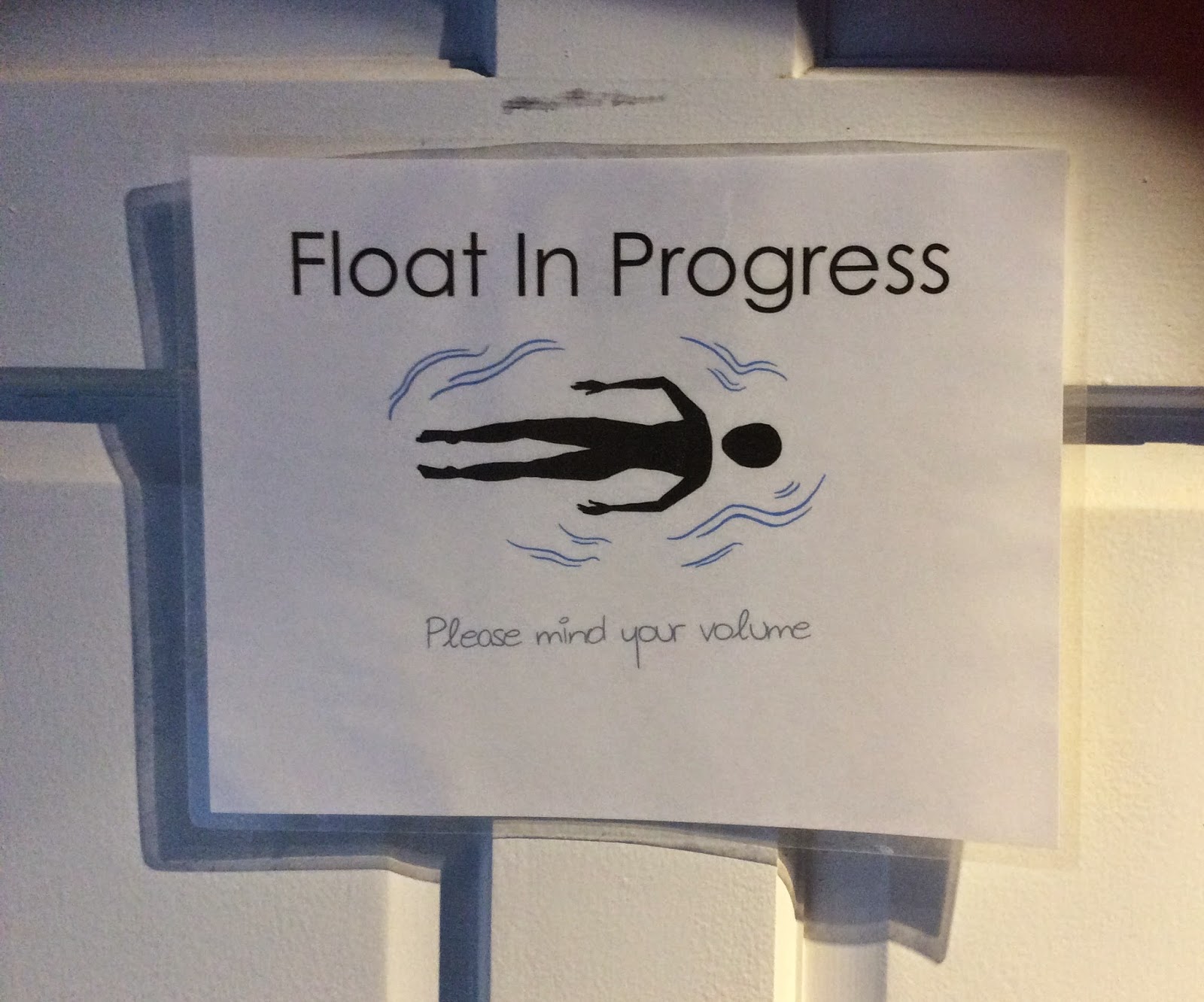
Floating - A Healthy Trip Into Your Mother's Womb and Your Own Twisted Mind


Floating is the new craze. Or if it isn't, it should be. It's the closest you get to tripping in a salty environment.

So you go to this place called Float On on SE Hawthorne in Portland, Oregon that looks like a gay sauna club from 1977. They have six float tanks, sell legal drugs over the counter, and if you don't watch your back they'll get you juiced up on herbal tea. Then you're put in your own saltwater tank that's the same temperature as your body. It's totally dark inside, no sounds reach you except for the beating of your heart (if you have one). After a few minutes you feel you're back in the womb of your mother or being embraced by stress-free archangels.

I've floated six times, and it's a great meditation unless you suffer from claustrophobia or a fear of imaginary sharks. The first time I got so bored I tried to drown myself though, but the salt keeps you afloat no matter what - and slowly you melt into the darkness like a humid little demon. Every muscle relaxes, and after a while your neck learns that the water isn't dangerous; it's your friend, your lover, your muse.

Some people get in touch with unknown anxieties when they float. Others have lucid dreams, or just empty their bladders into The Great Unknown. I've had two small flashes from past lives, and at one point I thought I'd invented the toaster, but when I came out somebody told me I was sixty years too late. I also DID empty my bladder, hoping it was a rite of passage because I don't want to be a Danish pig. But man, the water is SO relaxing, and the float hipsters clean it afterward with their state-of-the-art filtering system.

That's right, you get your own water to soil, including visions, longings, and ideas for your next novel or snack. Floating is not a trip down memory lane but a journey into
altered states you had no idea existed  - a scenic drive on the freeway of your subconscious. Or at the very least, you get saltwater in your eyes, which can be a religious experience, too.

So friends, followers, health nuts, I can wholeheartedly recommend an anti stress floating to anybody who can stand their own company for an hour and a half. Most people can't, of course. That's why they get iPhones, but that's another story altogether.

(Check out www.floathq.com here in Portland. However, they have float tanks several other places in the world)


This is a picture of the float I did this morning (it's me in the middle). Float On in Portland offers three kinds of rooms, two ocean floats, two oasis tanks, and two float pools. I like them all and they seem to like me.


Monday, June 9, 2014

Dammit, Why Did We Miss The Naked Bike Ride in Portland? (Sweaty Balls and All)


1.
I'm still disappointed I didn't make it to The Naked Bike Ride Saturday night in Portland. All those bloated bellies and saggy balls flapping in the wind.

My Pale Beauty and I wanted to go, but as everybody knows it's hard work getting naked. First you have to take off your clothes, then you need to make sure that your genitals are behaving.

But if God has blessed you with a great body, you have a responsibility to flaunt it. We belonged in that race, and I wasn't going to wear a sissy helmet or a g-string like all the Germans I know. No, I was going to get Danish and dirty, ripping off my helmet and shouting obscenities at Volvos.

The ride is supposedly part of The World Naked Bike Ride, an annual occurrence in Portland, San Francisco, and several pornographic cities in Europe. I've heard they even have one at Guatanamo bay. This year thousands of Portlanders biked through downtown to prove that riding naked is the thing to do when it's 56 degrees and your nipples are as hard as kidney stones.

2.
But as I said we never made it. My Pale Beauty and I had just stripped naked when we found a mouse in the house. The mouse raced through the apartment and hid under the sofa. I tried to get it out with a broom. When that didn't work I went New Age on the rodent. "I see God in you, so get the fuck out of there before I call Rent-a-Cat, okay?"

And it's true. I don't want to kill sentient beings; it's only people I feel like terminating. God, we did everything in our power to get rid of the mouse. First, we put on a noisy fan, then we ran around screaming like maniacs.

"No, we have to do something nastier than that," I said to my girlfriend and put on the latest Justin Bieber CD, but the mouse still stayed put. Later we found out that it had built a nest under one of the cushions. It was quite comfortable there, munching on tofu crackers and baba ganoush - the rodent even enjoyed watching Dancing with the Stars.

3.
So yes, My Pale Beauty and I missed The Naked Bike Ride. And we wanted to go so badly - not to show off, but as an homage to naked cyclists who are killed every day - by truck drivers wearing too much clothes.

So it's high time that we take action - and Saturday thousands of cyclists in Portlandia made the kind of political statement that can bring world leaders to their knees - at least if we hand them a pair of binoculars.


*****
This is a rewritten and updated version of my blog about The Naked Bike Ride in 2009. We still haven't caught the mouse, by the way.


Tuesday, December 10, 2013

A Course In Political Miracles: Marianne Williamson May Be High on Tofu But She Still Makes More Sense Than the Politicians on the Hill


1.
Marianne Williamson is running for Congress in California's District 33. 

If you have no idea who she is, it's probably because you need A Course in Political Miracles. Marianne wrote A Return to Love and is one of America's finest spiritual writers and teachers. One of her many homes is The New York Times bestseller list where she often stays for months. She is also Oprah's advisor in matters of the soul --- and surely you have heard of Oprah?

During a short trip to Southern California I went to a meeting for Marianne's many volunteers. (By the way, I'm allowed to call Marianne by her first name. Even her own website does: MarianneForCongress.com)

The volunteer meet-up took place in The Source, a beautiful spiritual center on Rose Avenue in Venice --- the kind of area where hippies wear Armani and order pizza with vegan crust. When I walked in, I was delighted to see mandalas, smiling Buddhas, and about 150 levitating volunteers who wanted to help Marianne get elected. I doubt Mitt Romney's headquarters looked like this. Romney never seemed like a man who would get Yogis excited about anything.

The Source is an old historical church with a saintly and serene atmosphere. (In America any structure built before 1980 is considered historical). Normally it's used for meditations, sacred chanting, and all those things that make Shirley Maclaine excited. The Source seemed like the perfect venue for a woman who is staring a movement that's based on the best four letter word of all, love. MONEY OUT, PEOPLE IN, as it said on a hand-out. Which downward dog wouldn't agree with that? 

2.
Since I'm a Dane from Portland who isn't allowed to vote in the U.S. (except for American Idol) I didn't know where to sit in the crowded church. All around me people were holding up signs, Santa Monica, South Bay, Marina del Rey etc, so I decided I belonged to Venice since I got drunk on their boardwalk once. Luckily I was graciously accepted into Venice's circle of volunteers, all of them sweet and enthusiastic.

When Marianne Williamson appeared, she impressed me. She was honest, passionate and didn't sound like any other politician. Instead of repeating the usual "Washington is broken" mantra, she talked about how WE are broken inside and how that affects the society we are part of. 

She also had a stern warning: "The American government is constantly chipping away at our democratic freedoms---one capitulation to moneyed interests at a time, one new gerrymandered district at a time, one government surveillance program at a time, one limiting of our voting rights at a time, one intimidation of journalists at the time, one Patriot Act at a time ... So at what point do we stand up to our own government and say, "hey, guys. Whose side are you on?"

This quote could easily have been used on Human Rights Day, December 10 when 562 writers from 83 countries (including Nobel prize winners like Umberto Eco, J.M. Coetzee, Orhan Pamuk, and little me) signed a petition called Writers Against Mass Surveillance that was printed in newspapers around the world, including The Guardian, Frankfurter Allgemeine, El Pais, La Repubblica, and Politiken. 

But Marianne Williamson went further at the meet-up in California. She promised to run an outer and an inner campaign, trying to raise consciousness everywhere, since we can't demand change from Washington if we don't change ourselves.

So from a spiritual  perspective we shouldn't just be angry with our government. We should see it as a frightened part of ourselves, obsessed with the fear of terrorism and love of control.
3.
Well, almost everything Williamson said that evening made sense to a spiritual airhead like me. She did NOT come across as if she had overdosed on soy milk. She was NOT a new age caricature but argued well. And thank God, she doesn't run for the Democrats but as an independent who wants love and dignity for everybody "instead of a sociopathic economic system that operates without a heart."

"I would be the happy if all my readers would donate as little as $5 to this campaign. In that case we would have more than enough money," Marianne said, finishing the evening with the kind of prayer you won't hear in Congress too often.

4.
But why should I go on about Williamson's Gandhi-like campaign? Go to her own website MarianneForCongress.com and see for yourself. Marianne Williamson is just one of many visionaries who knows that it's last call for humankind. Something has to be done about our fading democracy where money has such an obscene influence on what happens in Washington. Passing a decent law here and there isn't enough. We need a series of earthquakes to jolt us out of our self-absorbed empathy - you don't have to be Mamas & Papas to see that.

The question is actually simple: What is going to win in the end?  Love and trust, or fear and surveillance?  Most of the media and the establishment will definitely laugh at Marianne Williamson. But no matter what you think of a movement like hers, independent candidates are on the rise. How could they not be when Congress and Obama are fighting like toddlers? 

But perhaps Marianne Williamson could lead the way in America. Now that would be A Course In Political Miracles indeed.


....


Tuesday, November 12, 2013

Learning Italian in Lucca: Calvino, Puccini, Vaffanculo. It's All Poetry To Me


1.
During a short stay in Italy last month, I passed through Lucca in Toscany where it all started for me.

In the nineties I decided to do something I wanted since I was a kid: learn Italian. I suffered from depressions back then and since wine wasn't the answer, Italian had to be. Luckily I was right. The second I started to speak the most beautiful language in the world, clouds would evaporate in my head, beauty filled every cell in my body, and I came instantly alive, helped by the sun, the mountains, and the penne arrabbiata.

After half a year I could almost read Calvino and I could definitely shout vaffanculo. My writing became more vibrant, my digestion improved - how could it not since I was surrounded by saints, gelato, and language? Sometimes I would break down in gratitude, munching on words like melanzane and abbastanza, while getting high om condizionale. There was so much LIFE in Italy, so much forbidden fruit passing me on scooters, so much dirty linen hanging from lazy balconies, so many signs that blew me away: Campobasso, francobolli, caduta massi, all of them were poetry to me. The cities steeped in history reminded me of earlier incarnations as an actor in the Veneto region, a Franciscan monk in Urbino, and a mystic in Venezia.

At one point I dreamed of marrying Italy, but today I only want her as my mistress. I drop by as often as I can, knowing that all hill towns, lemon orchards, and mountain lakes will be in my blood until the day I die. In some ways I feel more Italian than Danish, except that I'm as impatient as most Scandinavians and I want things to work. But things don't really work in Italy. Italians thrive on chaos and temper tandrums, which is charming one month a year, not more. So come to think of it, I will keep my Danish passport for now...


2.
Lucca is the prettiest town in Tuscana. Forget overrated Firenze, crowded Siena. touristy Pisa, and ridiculous San Gimigniano. They are all fine if you like Disneyland. No, Lucca is the real deal. It's quiet, sleepy, stylish, and magical at night when all the tourists have gone back to their cruise ships and the five star hotels in Florence.

The greatest thing about Lucca is that it doesn't have a single "important" thing that snobs have to see, except for Le Mura, the walls around the old city that may be the greatest place in Central Italy to walk your Schnauzer, or go for a jog. Lucca is a city for people who truly love Italy. But I'm only talking about centro storico, of course. Everything outside le mura is uninteresting and a little drab, except for a cute stream and a few good restaurants.


3.
I started learning Italian at Koine in Via Mordini in 1994, came back several times the following years, continued my studies at E.St.Veneto in Feltre (a lovely place) and in Perugia where I survived the big earthquake and the chocolate. 

Around 2000 my Italian was pretty damn good, but now it has deteriorated because I live in America and can't drop by as often as I would like. But literary as I am, I still read Corriere dello Sport and Stefano Benni's short stories. I listen to Zucchero and Irene Grandi, admire the hell out of the films by Paolo Sorrentino, and I love the art of Canaletto and Andrea Pirlo. Italy is part of me and has given me so much joy and inspiration. At least four of my thirteen novels were partly written in one of the greatest countries on earth, the obscenely beautiful and delightfully dysfunctional Italia.

Take an Italian class in Italy. When I started I only knew how to say, due cappuccini, so there's hope for you as well.


Back in the early nineties in Rome where I only understood the football scores in the sports paper.

*****

Monday, October 14, 2013

The Rescue of the Danish Jews in October 1943: My Grandfather Was One of Them


Seventy years ago today, my Jewish grandfather David Huda escaped to neutral Sweden in the bottom of a fishing boat. He went off from Gilleleje in Northern Seeland in the middle of the night with eight others. The rescue was beautifully organized, and seven thousands Danish Jews got away during October 1943. 
Denmark has always taken pride in the fact that we saved 92% of our Jewish citizens. However, one of many reasons we were so successful was actually because of the Germans. Most of them weren't interested in catching the Jews, since there wasn't much anti-semitism to play into in Denmark. So the Wehrmacht made the  calculation that prosecuting the local Jews only would create more trouble in a country that finally had started to fight back against the German occupation.
Two weeks after my grandfather escaped, my Christian grandmother, uncle, and mother followed from Kalkbrænderihavnen in Copenhagen. My half-Jewish Mom was ten years old in October 1943, deadly scared that Gestapo or the German soldiers were going to find them. But everything went smoothly. They met up with my grandfather in a refugee camp in Molle, Scania (Skåne) and stayed in seven different places in Sweden until Denmark was liberated in May, 1945 by British and American soldiers.

Before the war, my family lived in Kibæk in rural Jutland. My grandfather was the only Jew in the  area, and definitely the only Christian Jew since he had been forcibly converted when he arrived from Palestine in 1906. 


In early 1943, my grandfather joined a small resistance group that hid English agents in their barns. He also was crazy enough to befriend a soldier from Vienna at the same time. Call it intuition because the German-Austrian soldier ended up helping my grandfather escape in October 1943. 
In 1998 I told David Huda's amazing life story in Drømmeren fra Palæstina (The Dreamer From Palestine). It was my first best seller in Denmark and was later translated into French as Le Reveur de Palestine (Gaia Editions, 2005). One day I hope it will come out in English and in many other languages as well.
Needless to say, I miss my whole family like crazy these days. They all survived the Second World War, but one of them died in June 1945. That story you can read as well in Drømmeren fra Palæstina. You can download the ebook (ebog) here from Arnold Busck in Danish.
 
My novelized biography from 1998 (Lindhardt & Ringhof) came out in five editions. The book sold out a long time ago, but it was re-released as an audiobook last year. You can download the Danish audiobook here and listen to it immediately http://www.altfortalt.dk/17572-drommeren-fra-palastina.html
I presented the French edition at the book festival Litterature Europeenne Cognac in France in 2006. I still count that as one of my greatest moments as a novelist.  You can still buy the French edition from Gaia Editions on Amazon.


 My mother Marie Søndergaard Huda in Dalarne, Sweden in late 1944. 
 
My grandmother Marie Angelique Søndergaard Huda and my mother half a year before the German occupation. 

 David Huda wrote his own life story in 1950 called Fra Haifa til Hammerum Herred. Funnily enough, my novelized biography from 1998 was much closer to the truth than his own autobiography, because my grandfather chose to leave out some of the most dramatic and painful events. I put them in which was important to my mother as well.
I partly based The Dreamer from Palestine on his book, my mother's recollection, and most of all, my own imagination. There were so many holes and half-truths in my grandfather's story that I used it as a template to write an epic novel about one of 20th century Denmark's first immigrants. But I'm still loyal to what actually happened in Safed, Jaffa, Jerusalem, Kibæk, Herning, Copenhagen, and Sweden during my maternal granddad's 82 years on planet earth.
God bless you David, Erik, Marie, and Marie. I hope you read this blog wherever you are.
........

Thursday, September 26, 2013

Homage to Indie Book Stores Everywhere. What Would We Do Without You?


In a small town on Spanish Ibiza, there's a small book store called Libro Azul. Earlier this summer, I went there with a friend to buy her a small gift. My first choice going in was Siddharta by Hermann Hesse, followed by The Magus by John Fowles, and The Wind-Up Bird Chronicle by Murakami (Arundhati Roi's The God of Small Things or Olga Tokarczuk's House of Day, House of Night would be great, too)

I knew it was a long shot that a small indie store would have those books in English. I expected a bland soup of Da Vinci Codes, 1001 Shades of Gray, and icy Swedish thrillers where even the prose has been viciously beheaded. My friend and I walked straight to the small English section that consisted of about three hundred books, and to my shock this small independent book store in sleepy Santa Gertrudis on Ibiza had the first three!

That's right. Out of three hundred books in English, Siddharta, The Magus, and The Wind-Up Bird Chronicle were all there!

"What a fantastic selection you have," I said to the owner, trying hard not to hug him to death and shower him with the kind of atrocious kisses you would expect from deranged novelists.

"I want people to read good stuff," he said with a shrug, "so when they ask for a bad book, I try to convince them to buy a good one." He picked up The Big Book of Pussy that was lying on the front desk for all kids to see. "With a few exceptions, of course," he added with a big smile.

A few minutes later we walked out of the store, with the firm belief that independent book stores will survive absolutely everything, including cockroaches and who knows, maybe even Amazon?


A young reader dreaming of Harry Potter and Pippi Longstocking?  What would she do in a world devoid of small indie book stores that prefer pulp from the sublime?  Even kids can't be online all the time. So I've been told, anyway.
******

Wednesday, July 31, 2013

Election in Zimbabwe: Please Don't Be Cruel to Robert Mugabe. He Is Such a Sensitive Dictator


 1.
Please don't be cruel to Robert Mugabe.

Mugabe is such a sensitive dictator. And as we all know, sensitive dictators don't have any sense of humor. They are too busy torturing poets and worrying about their stool. So have a heart, have a little compassion for this aging dictator who may or may not become Dictator of the Century in Zimbabwe at this year's election.

To tell you the truth, no matter what happens I feel sorry for Robert Mugabe. I wouldn't want to swap lives with that man. Too many power hungry spirits are building nests in his short hairs. Too many vicious people are making fun of this proud leader who has never lost an election. Even when he has lost an election.


2.
Let me mention some of those people that humiliated him not that long ago: Raisedon Baya, Christopher Mlalazi, Aleck Zulu, Lionel Nkusi. These scoundrels had the audacity of writing and producing a play called The Crocodile of Zambezi. It premiered May 29, 2008; the writers and actors had worked on it for two years.

The play took place in a fictional country, depicting a weak 94 year old dictator in the middle of a crisis.

Robert Mugabe in crisis?

Don't these artists understand that Robert Mugabe was appointed by God? Does God have a crisis? Of course not. God takes care of business as He sees fit. God is in perfect control and if He doesn't win the elections, He still wins the elections. That's why He is so loved by His people.

By the way, Robert Mugabe didn't like that play back in 2008. Actually, He never saw it. Dictators don't have time for the arts. Well, maybe they listen to Wagner or watch the odd rerun of The Sopranos, but satire, no, that's not their kind of thing. Adolf Hitler never laughed at Charles Chaplin, and Osama bin-Laden wasn't too fond of Jon Stewart, only American porn. These are facts whether you like them or not!

So back in 2008, Robert Mugabe sent some of his boys from the secret police. They rounded up the actor Aleck Zulu and the production manager Lionel Nkosi and gave them a ride in their car. They tortured them and put a gun in their mouths. Maybe they broke a few limbs as well because you shouldn't insult the man who has given so much to his subjects .... sorry, co-patriots.

The play, by the way, was closed down after one performance, which is totally understandable, because who in their right mind would want to see a play making fun of the Supreme Savior of Zimbabwe? Instead these artists should lavish Mugabe with praise. They should write pompous poems to glorify His strength, they should construct endless bridges in His name, or create religious cults instead of telling lies about this Glorious Incarnation of Light.

3.
As I said, Robert Mugabe is a sensitive dictator. And maybe He sleeps a little better when plays like that close down. Maybe He's even proud that this election will be a little less rigged than the ones before?

So have a little compassion, have a little heart. Not for Zimbabwe but for Roberto Mugabe. The poor man had a difficult childhood. So why shouldn't the rest of his people?


****

Rewritten blog from 2008. 

This entry is dedicated to the brave people of Zimbabwe who have the courage to laugh through tyranny, and to organizations like American and Danish PEN that tirelessly work for protecting the freedom of speech in countries like Zimbabwe. I'm proud to be a member of both. The brilliant cartoon above is all over the net, but I haven't been able to find out who the artist is.

*****

Sunday, December 23, 2012

SOS Children's Villages: Sponsor Uncle Just Loved Visiting His Kid in Bangalore, India


Sponsor Uncle has a lovely daughter in Bangalore, India.

Her name is Keerthana, and she has lived in the local SOS village since she was three. Keerthana is ten years old, soon to be eleven, and she has a rich life with a mother and ten other kids in a nice house. Keerthana is probably the most quiet and understated of the bunch----very appropriate since her Sponsor Uncle is a bit of a showboat.


Sponsor Auntie couldn't make the trip to Southern India, but she's proud of Keerthana, too. We had bought her a nice gift: an orange bag with crayons, pens, and a big notebook. Keerthana was very pleased since she likes to draw pictures of nature. She is good at running, too---a talent she luckily didn't put to use when Sponsor Uncle visited ...


During my stay Keerthana glowed in her beautiful dress. And so did her silly Sponsor Uncle who had a lot of fun with her great, naughty siblings. If I could, I would have stuffed them all in my suitcase and brought them back with me, but India has strict rules against that, unfortunately.


When Sponsor Uncle left the SOS Village to go back to his writer's residency at Sangam House he was moved beyond words. But his Indian cab driver soon got him down to earth.

"You pay $40 a month for an Indian kid?" he asked looking at me like I was some kind of a moron.

"Yes, and I love it."

"I can get you five kids for that price," he said and drove me into the heavy fumes of the Bangalore traffic.

Well, thanks to the many SOS Children's Villages around the world, thousands of orphans and poor kids can sleep safely at night and get an education in loving surroundings. And you can sponsor one of them as well, if you like. There are SOS Villages around the world. SOS is active in 133 countries, and you can read about it here.

Thursday, December 6, 2012

How I Lost My Heart to Nepal and the Tibetans in Boudha


I totally lost my heart to Nepal and the Tibetan community in Boudha. 

I was in town to do two readings at an international writers' festival that actually was cancelled, but since a lot of us had received grant money to attend, ten of us showed up, anyway, including Vikum Seth from India, slam poet Sarah Kay from New York, and my Danish colleague Sally Altschuler. 

The brilliant director of the Literary Jatra, Suvani Singh quickly arranged a lot of events for us, and to my surprise they were all well attended. Sarah Kay kicked some serious ass in Thalem, Vikum Seth disappeared from the face of the earth, and I presented The Tsar's Dwarf and my take on writing historical novels for a large group of wonderful writers, poets, and journalists at ICER college. And I read at the Storytellers' Union along with Sally Altschuler and five local storytellers.

When I wasn't working I walked around Boudha outside Kathmandu in awe, getting up at dawn to circle around one of the world's biggest stupas in the company of Tibetan monks. I loved it and was incredibly moved by the whole experience.


In Boudha I stayed at the Tibet International hotel only 300 meters from the stupa and would recommend it to anyone. The people working there were absolutely wonderful. After a few days, I'd almost fallen in love with three receptionists and with the roof terrace where there was a great view of the stupa and the snowcapped Himalayas.

Well, pictures speak louder than words (as a novelist, I hate that saying) but here are a few photos from my great week in Nepal and Boudha.


Kathmandu is a ride. But leave your lungs at home. They won't like the place half as much as you will. And the Nepalese are adorable. Please invite me again, won't you?

***********************