Humorous travelblog and website for Peter H. Fogtdal, author, raccoon lover, human being.
Read The Tsar's Dwarf (Hawthorne Books)
Wednesday, October 10, 2012
My Reading In Helsinki, Finland: What a Sauna of Love!
The first time I was in Finland I was almost beaten up by two Finnish thugs in a bar.
They didn't like my Greenpeace sticker, and when they found out I'd just been to Moscow, they were convinced I was a Commie. "We like to kill them," one of the psychos told me with a smile that would have made Hannibal Lecter proud.
But last month I was back in the Land of Nokia to present The Tsar's Dwarf (Zarens dværg) in Helsinki. And this time no one tried to bash my head in. Helsinki was sunny and friendly like a sauna of love.
My reading took place at a downtown library. Fifty wonderful Finns and Danes laughed, applauded, and fed me cheese. I spoke to Finns Who Love Denmark Because We Sound So Weird, Danes Who Married Finns And Don't Mind Too Much, and Finns Who Married Danes But Now Can't Get Rid Of Them. There were some great people from The Danish Club and the embassy as well. Even the Ambassador was cool.
I sold a lot of books, too and signed the odd body part.
I did, however, experience some drama. In the airport bus I lost my credit card, but got it back two hours later.
"The Finns are extremely honest," my Danish host, Claus Elholm Andersen told me. He teaches Danish lit at University of Helsinki and recently moved to Helsinki from San Diego. Talking about dedication to the tundra! Claus is the man with the red shoes in the top photo. Whatever gets you through ten months of winter is fine with me, Claus.
Here are some more pictures from Helsinki. The Finnish capital isn't a bad place to hang out. And the sweet smell of Vodka is everywhere, especially in the trams in the morning. So God bless the Finns. They put up with the Russians for centuries, and now they've put up with me.
Monday, August 20, 2012
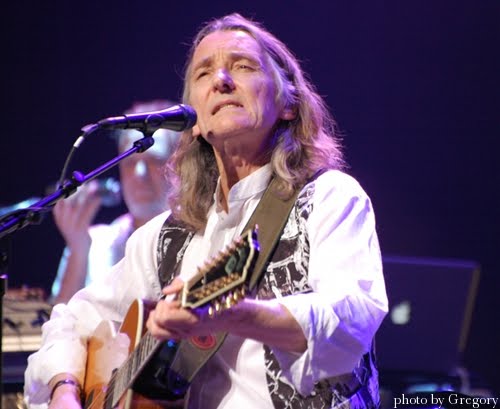
Supertramp's Roger Hodgson in Concert at the Oregon Zoo: Even The Giraffes Got So Excited They Tried To Headbutt This Musical Genius
Sometimes I can't stand all the beauty in the world.
Nine days ago was one of those days.
Roger Hodgson, the lead singer from Supertramp, had the audacity of visiting Portland, where he played some of the classics he wrote in the Seventies and Eighties. If you don't know what songs I'm talking about, let me just mention Give A Little Bit, Breakfast in America, The Logical Song, Dreamer, It's Raining Again, and Take The Long Way Home
The concert took place at the Oregon Zoo in front of orangutangs, leopards, and an enthusiastic crowd of aging hippies. The giraffes got so excited they tried to run up to the stage and headbutt Roger Hodgson, but he was probably protected by Babaji and a hundred other saints.
Goddammit, I don't want to admit how much I was moved by that concert. Not just because Roger Hodgsons songs were the soundtrack to my pimples, but because he is one of the most spiritual singers around.
Listening to Roger is like being in the company of an archangel of music. Like all truly great artists, Hodgson downloads songs from Heaven. I was crying when the old hippie played Hide In Your Shell, one of the most beautiful songs ever written. Equally great was Lord Is It Mine, a modern psalm. Johann Sebastian Bach probably gave it to Hodgson in a dream, and I don't think Bach regrets that!
So, Roger Hodson, I'm very impressed with you. But don't you dare come back to Portland, Oregon! Frankly, I'm not sure the giraffes and I can stand that much beauty.
Guitar photo of Roger Hodgson by Gregory Weinkauf
****************************************
Thursday, July 19, 2012
My Weird and Incredible Meeting With Israeli Author Meir Shalev (Which Just Goes To Show How Small The World Is)
Meir Shalev, the award-winning Israeli author who was one of the many participants at World Voices 2009 in New York.
1.
Life is a funny and strange four letter word.
Three years ago I was an official blogger for PEN at World Voices in New York. At the party in a fancy midtown hotel on Manhattan I ran into Meir Shalev, the famous Israeli author.
I'd seen him on a panel a few days earlier where he'd made a wonderful impression, but apart from that I knew nothing about him. But after talking to the man for less than two minutes, I found out that he once met my Jewish Danish grandfather!
My totally unknown grandfather.
From a small town in Denmark. Far from New York and Israel.
Thirty-one years ago.
Ladies and gentlemen, how weird was that?
2.
All this came to light just because I bragged to Shalev about being 25% Jewish (my left leg?). My maternal grandfather was born in Safed in 1898 and was abducted by a Danish missionary under mysterious circumstances, ending up in my cold Scandinavian country as a frightened six year old.
"Oh, yes, yes" Meir Shalev told me, "I've heard that story before. He was baptized against his will, wasn't he? His name was David something. Actually, I met your grandfather twenty five years ago when I was in Denmark. He was a very interesting man."
I stared at Shalev. Was he a mind reader or some kind of memory psycho? Or was I on drugs without knowing it? But then again anything can happen in New York. Some one could have slipped a Semitic pill into my Chardonnay to take advantage of my body - or more likely, to force me from writing more novels.
Meir Shalev continued: "I met your grandfather through Herbert Pundik (a renowned Danish journalist and editor). Then I took the train and visited him an hour and a half from Copenhagen. He lived in the countryside in a beautiful house by a small pond."
I nodded and kept on staring at this strange Israeli writer. This was all too surreal, but at the same time, my granddad's life story was so incredible that most people would remember it if they heard it.
In 1998 I wrote a novelized biography about his life called Drømmeren fra Palæstina (The Dreamer from Palestine). It was my breakthrough to a larger audience in Denmark and stayed 85% true to the real events of his life, but unfortunately, the novel isn't out in English. It was published in French as Le Rêveur de Palestine (Gaia Editions, 2006), and got a rave review from French critic Mazarine Pingeot-Mitterand at the Salon de la Littérature Européenne de Cognac (Cognac Festival for European Literature) in 2006.

3.
My maternal granddad's name was David Huda. He was the son of a Arab father and a Jewish mother, and he was abducted by a Danish Christian missionary when he was six, probably because his Arab Christian father wanted him to have the "right" upbringing.
Then David was brought to Denmark and forced to live in a strange land with a pair of cold, Lutheran foster parents who tried to turn him into a "good" Dane. At that time, no one had dark skin in Denmark, so my grandfather was considered a freak or a circus act by the farmers of Kibæk in Western Jutland.
My granddad's Christian baptism in 1906. The poor kid had his curls cut off and put in a white robe that made him look like a girl. The event traumatized him for life.
4.
On so many levels, David Huda's life has been important to me. My grandfather was a charismatic man with a great sense of humor, and the novel/biography I wrote about him was my breakthrough in Denmark to a bigger audience.
"I remember that David Huda escaped to Sweden during the Second World War in the bottom of a fishing boat," Shalev said. "He was very ill of cancer when I visited him in the early Eighties, but he made quite an impression on me."
I nodded. My granddad died in February 1982 but had just come alive on Lexington Avenue in New York on a cold May day, resurrected by a wonderful Israeli author I'd never heard of before and who definitely hadn't heard of me.
But maybe I shouldn't be so surprised. American PEN and World Voices are about connecting writers from around the world. Well, what can I say, PEN? You're doing a damn fine job!
Drømmeren fra Palæstina (Lindhardt & Ringhof) will be out as an e-book in Denmark this summer. And it will re-released as an audiobook as well, so my old novel/biography is getting a small revival.
******
1.
Life is a funny and strange four letter word.
Three years ago I was an official blogger for PEN at World Voices in New York. At the party in a fancy midtown hotel on Manhattan I ran into Meir Shalev, the famous Israeli author.
I'd seen him on a panel a few days earlier where he'd made a wonderful impression, but apart from that I knew nothing about him. But after talking to the man for less than two minutes, I found out that he once met my Jewish Danish grandfather!
My totally unknown grandfather.
From a small town in Denmark. Far from New York and Israel.
Thirty-one years ago.
Ladies and gentlemen, how weird was that?
2.
All this came to light just because I bragged to Shalev about being 25% Jewish (my left leg?). My maternal grandfather was born in Safed in 1898 and was abducted by a Danish missionary under mysterious circumstances, ending up in my cold Scandinavian country as a frightened six year old.
"Oh, yes, yes" Meir Shalev told me, "I've heard that story before. He was baptized against his will, wasn't he? His name was David something. Actually, I met your grandfather twenty five years ago when I was in Denmark. He was a very interesting man."
I stared at Shalev. Was he a mind reader or some kind of memory psycho? Or was I on drugs without knowing it? But then again anything can happen in New York. Some one could have slipped a Semitic pill into my Chardonnay to take advantage of my body - or more likely, to force me from writing more novels.
Meir Shalev continued: "I met your grandfather through Herbert Pundik (a renowned Danish journalist and editor). Then I took the train and visited him an hour and a half from Copenhagen. He lived in the countryside in a beautiful house by a small pond."
I nodded and kept on staring at this strange Israeli writer. This was all too surreal, but at the same time, my granddad's life story was so incredible that most people would remember it if they heard it.
In 1998 I wrote a novelized biography about his life called Drømmeren fra Palæstina (The Dreamer from Palestine). It was my breakthrough to a larger audience in Denmark and stayed 85% true to the real events of his life, but unfortunately, the novel isn't out in English. It was published in French as Le Rêveur de Palestine (Gaia Editions, 2006), and got a rave review from French critic Mazarine Pingeot-Mitterand at the Salon de la Littérature Européenne de Cognac (Cognac Festival for European Literature) in 2006.

3.
My maternal granddad's name was David Huda. He was the son of a Arab father and a Jewish mother, and he was abducted by a Danish Christian missionary when he was six, probably because his Arab Christian father wanted him to have the "right" upbringing.
Then David was brought to Denmark and forced to live in a strange land with a pair of cold, Lutheran foster parents who tried to turn him into a "good" Dane. At that time, no one had dark skin in Denmark, so my grandfather was considered a freak or a circus act by the farmers of Kibæk in Western Jutland.
My granddad's Christian baptism in 1906. The poor kid had his curls cut off and put in a white robe that made him look like a girl. The event traumatized him for life.
4.
On so many levels, David Huda's life has been important to me. My grandfather was a charismatic man with a great sense of humor, and the novel/biography I wrote about him was my breakthrough in Denmark to a bigger audience.
"I remember that David Huda escaped to Sweden during the Second World War in the bottom of a fishing boat," Shalev said. "He was very ill of cancer when I visited him in the early Eighties, but he made quite an impression on me."
I nodded. My granddad died in February 1982 but had just come alive on Lexington Avenue in New York on a cold May day, resurrected by a wonderful Israeli author I'd never heard of before and who definitely hadn't heard of me.
But maybe I shouldn't be so surprised. American PEN and World Voices are about connecting writers from around the world. Well, what can I say, PEN? You're doing a damn fine job!
Drømmeren fra Palæstina (Lindhardt & Ringhof) will be out as an e-book in Denmark this summer. And it will re-released as an audiobook as well, so my old novel/biography is getting a small revival.
******
Sunday, February 12, 2012
A Warm Tribute to Damascus and Syria (In Photos, Anyway)
I wish I could write something funny about Syria, but what's taking place in that country right now is incredibly sad.
After eleven months of uprising, fighting has spread to gorgeous Damascus where so many artists and academics have stayed at the Danish Institute, working on their books, art, and projects. The old part of the capital is one of the most fascinating places I have visited in my life, and I loved the Syrians who are a warm and generous people.
Parts of my two latest novels, Skorpionens Hale and Zarens dværg (The Tsar's Dwarf, Hawthorne Books) were written at the institute in Souq Madhat Basha, close to the beautiful Umayyad mosque. It's hard not to be inspired when you "have to" walk through 1001 Nights just to get a shawarma. "Welcome," was the greeting everywhere, and you actually did feel welcome in Damascus where St. Paul got his visions two millennia ago.
So this post is a small homage of pictures from my three Syrian visits where I met so many warm and helpful people. I hope they're doing well right now, but I doubt it. The Assad regime has always been brutal, and unfortunately it's showing its true colors to the world right now.
May Allah be with every single Syrian who wants to live a life in freedom and peace!
All photos copyright by Peter H. Fogtdal, Danish Accent.
Blog entry from my latest stay in Damascus in 2007, Damascus Is A Dream But Lesbians Are Not Allowed
****
Tuesday, December 27, 2011
There Is Nothing More Powerful Than Yoga (Unless You Hate It, Of Course)
1.
I absolutely adore yoga. It's like having sex with yourself - a spiritual cleansing, a divine form of masturbation that has been passed down from Indian saints who didn't know how to keep warm in the Himalayas. I totally believe you can become enlightened by mastering your body - I'm just not sure I have one.
Yes, you guessed it, I only like yoga in theory. When my body sees a yoga mat it wants to run away and munch on a pork sandwich. It doesn't want to breathe through migraines; it doesn't find any joy in "allowing" the pain from a cracked collarbone. My body wants greasy tacos, sex in phone booths, and long bike rides around nuclear plants.
So why do I keep on torturing myself with the Downward Dog and other unhealthy yoga positions? I've done yoga on Greek islands and dengue at a health spa in Thailand. That's right, dengue at a health spa. God is trying to tell me something. "Stay away from yoga," God shouts with that booming voice of His that worked so well for Charlton Heston.
2.
Right now I'm sitting at Kalani Oceanside Retreat in the rainforest on Big Island, Hawaii, and it's so serene it gets on my nerves. Alcohol isn't allowed, but anal sex is, so it's not all dull.
Actually, people are absolutely warm and beautiful. In my group you find a Latvian healer, a musician from L.A. with a gift for Zin Wine, a chocolate sales executive who despises chocolate, and an ex-con from the Oakland ghetto. The food is so healthy and tasty you want to scream, and unfortunately our yoga teacher Will is absolutely great. He even has a sense of humor, something I thought was strictly forbidden on the spiritual pathway. And hey, there's a reclining Buddha overseeing my declining body when I go snorkeling in the pool. With a life guard like that, how can you drown?
So yes, you could refer to this lush rain forest as Paradise, but damn it, there's nothing at Kalani to keep me on my toes. When I visited ashrams in India and Thailand you had to watch out for snakes and monkeys jumping on your back. On Big Island nothing can kill you. You may see a dolphin or hear a whale, but even though this is a spiritual place whales tend to keep to the sea - they're not much for doing The Plow.
3.
By the way, I love mediation much better than the medieval torture that passes for Kundalini yoga. I'm also pretty good at breathing. Without bragging I can say I've done that successfully for half a century.
A few days ago I almost reached Enlightenment. I suddenly found myself fondling the most beautiful woman in the studio which happened to be my girlfriend. And I felt like fondling a few others as well, since I believe it's very important to share your wealth, but unfortunately my guardian spirit told me to stop.
4.
But excuse me, I have to leave you now. There's an Ecstatic Dance taking place in the Rainbow Room here at Kalani. You're supposed to chant and rub your chakras against the other yogis while you chant something incredibly deep in Sanskrit. You just can't go wrong with that, now can you?
Link to the gorgeous Kalani Oceanside Retreat where egos go to die (some more than others)
**********
Thursday, November 10, 2011
Forgive Me, Berlin, But I Miss The Wall and The Gloomy Marxists With Their Bad Haircuts
1.
I'm in Berlin for the first time in more than thirty years.
It's a fun, vibrant city full of cafes, trendy neighborhoods, and friendly people with oversized lap tops. Prentzlauer Berg is hard not to like. So are Bergmannstrasse and fashionable Unter den Linden with the wonderful Berlin museum, but the more I walk toward Brandenburger Tor the more I miss the wall and good old gloomy East Germany.
Not because I liked the German Democratic Republic or DDR. No one did unless they were deranged. East Germany was the most unpleasant country in the world at that time, but it was exciting the same way a nightmare is exciting. The collective paranoia crept into you and made you look suspiciously at every zombie-hausfrau who passed you in the street, most of them smoking Bulgarian cigarettes that smelled worse than the factories.
2.
Yes, that's right, visiting East Germany was like walking into a black and white film with incredibly bad props. People drove around in Skodas and Trabants. The East Germans wore dreadful clothes and had haircuts that made Danish degenerates like me roar with laughter. Alexanderplatz in the late seventies was a paradise of asbestos and huge red banners, teaching us that the Party decided what we should say and think.
God, I loved the Deutsche Democratische Republik the same way you love your undertaker. It was definitely my "favorite" dictatorship because the Poles and Romanians were too friendly. In Hungary the food was too delicious to being real Marxist, but the East Germans got it right: They despised everybody and were downright rude toward capitalists who didn't bow before their Holy Trinity of Marx, Engels, and Hoenecker. But still they dreamed of hiding in your suitcase when you went back to West Berlin.
"God, it must be so exciting to live in this workers' paradise," I used to think stupidly, "they have microphones in the ashtrays just like in the movies, and when somebody knocks at your door in the middle of the night, you know it's not your boring neighbor but some Stasi with a gun."
3.
My fondest memory of my two trips to East Germany was visiting my pen pal, a girl from Halle who dreamed of escaping to the West.
One late night we sat on a bench in Alexanderplatz and kissed. It was one of those three minute kisses you have to be a teenager to endure. We never came up for air, we just kept on kissing ... but while we were at it, I felt something was wrong. I looked up and saw that a police car slowly went by eying us suspiciously. Then it disappeared, but one minute later it came back. An officer rolled down the window and said something sinister to us, so we got up and continued somewhere else. East was meeting West. In our mouths, anyway.
4.
Berlin today is quaint and exciting but not a favorite city of mine. One of my favorite places today is Kollwitzplatz. And there's something wonderfully ridiculous about the biggest tourist trap of them all, Checkpoint Charlie where I buy a piece of the Wall that I add to my impressive collection of ridiculous relics like two expensive splinters from the cross on Golgatha.
5.
I leave modern day Berlin after three days, but what I'm going to miss the most is the Club Colas they used to serve in DDR. They always tasted like Cokes that had been left open on a kitchen counter for a decade. No wonder that East Germany ceased to exist. There's only so much suffering humanity can take, anyway.
Thursday, November 3, 2011
No Wonder I Feel Right At Home In Gdansk, Poland (In The Company Of A Certain Naked Woman)
1.
I'm presenting my novel The Tsar's Dwarf at Uniwersytet Gdanski in Poland, and no wonder I feel right at home.
A few minutes before my reading I run into The Little Mermaid. She's sitting stark naked in the hall trying to read Søren Kierkegaard. No wonder she looks depressed. But I've always been a fan of our national symbol, so I decide to cheer her up by gently stroking her breasts. She gets quite aroused, of course, and as you can tell from the picture I get tired from my handiwork.
Actually, I love the fact that the Danish national symbol is visiting Poland. We have a duty to share her with the world, so first The Little Mermaid went to Expo in Shanghai, and now she's hanging out at Uniwersytet Gdanski hoping to get laid.
"Your Danish mermaid used to sit in the Norwegian class room, but we got so sick of her we threw her out," Hilde, the Norwegian instructor tells me with a cruel smile. But I forgive her. I always forgive Norwegians. That's how loving a person I am.
2.
Gdansk is beautiful. I had no idea that the historical center was so breathtaking. It took me back to the happy days of 1716 when everybody wore powdered wigs and didn't worry about the Euro.
Seriously, if I'd known that Gdansk was this gorgeous I would have gone years ago. Gdansk is only 50 minutes by plane from Copenhagen, but it seems like another world. The prices are low, the graffiti in the train stations are awesome, and people really know how to drink. And hey, I'm deeply impressed with the language as well. The Poles don't believe in vowels. They were forbidden by law a long time ago and they seem to have a kinky love affair with the letter Z. They put it absolutely everywhere, especially in places where it doesn't belong.
But as I said, what impresses me the most is the old part of Gdansk. It was expertly rebuild after the war and it really should be a major tourist attraction for those of us who love the baroque period.
Thursday, October 6, 2011
How To Milk a Danish Cash Cow (A Holy Scam In Varanasi, India)

1.
I'm in love with India. I've been here about eight times. I love the deep spirituality of this great country. And when I get tired of God, there are always the strong colors, the gorgeous scent of urine, and the palak paneer they serve in the small guest houses.
India is full of surprises, too. Yesterday I ran into three holy cows and Goldie Hawn. And I was head butted by all four. Yes, I'm truly blessed.
This time I'm here to do research on my next novel. It takes place in Varanasi, the holiest of all cities in India. Varanasi (Benares) is the famous place where you wash away your sins in Mother Ganges. And cremate your loved ones at the same time. You could argue that Ganges is the biggest funeral parlor in the world. Or the most impressive sewer in history.
Varanasi is India at its best and worst. It's colorful, charismatic, loud, polluted, dirty, generous, kind, obnoxious, spiritual, beautiful, and a haven for scam artists, con men, and monks with an advanced degree in pick pocketing. Everybody wants something from you. Sometimes it's your soul, but mostly it's just your damn rupees.
I ran into a delightful scam the other day. Since I know how to navigate in India, it didn't take me totally by surprise. But sometimes I'm not as cynical as I like to think, so let's say I was mildly disappointed. While roaring with laughter at the same time.

2.
I was walking down the atmospheric alleys of the old city avoiding the cow dung, the one-armed beggars, and the scrawny cows feasting on filthy plastic bags.
A man came up to me and started to talk. His English was fine, so we chatted for a while. At one point he asked whether I wanted to see the burning ghats - the place where the dead are cremated before their ashes are spread over Mother Ganges.
I said, sure, and we went to a house that supposedly was a hospice for the poor. Here people come from all over India to die and are taken care of for free. I was greeted by a little old lady in a dirty sari.
"This is The Mother Teresa of Varanasi" I was told, and then I was introduced to a guru in a dhoti and two volunteers. A "pious" looking gentleman lead me up to the roof of the patient-free hospice, so I could get a good view of the cremations at the nearby ghat.

"You have to understand, we're not asking for money. We're all volunteers at this hospice," my guide said.
I nodded, knowing that when a con man says he doesn't want money, things are going to get very expensive. But I went along for the ride for the simple reason I wasn't 100% sure whether this was a scam or not. Yet.
From the roof top there was a nice view of the Ganges and the three platforms where the dead are burned: One for the upper cast (business class?), one for the middle cast (coach), and one for the lower cast. The fire that was used for the cremation was lit thousands of years ago and had never gone out, my guide told me while meditating on my pin codes.
I started to cough because of the heavy smoke. I've always been sensitive to inhaling the deceased, especially Brahmins.
My guide stared at me through the fumes with that pious look he had practiced in front of the mirror, "Look around, Sir. Look at all the people carrying the dead bodies. Do you see any women?"
"No."
"Women are not allowed to attend because they cry. Crying holds back the soul. It's very selfish to show emotion, Sir."
"Well, sometimes men are emotional, too," I said.
"Yes, but men are not women," the Pious One answered with surprising contempt. Then he told a story about a widow who threw herself on the fire to be with her dead husband. This unfortunate incident happened ten years ago and meant that women had been banished from the cremations ever since.
After ten minutes of watching I'd had enough. Even though there was something sad but beautiful about the cremations, there was a limit to how much of a voyeur I wanted to be. When I got downstairs, the guru was ready to bless me as a token "for the large donation I was going to give to the poor".
"The small donation," I added quickly.
The guru in the dhoti asked me to kneel and put a warm hand on my head and started praying. I liked looking into his eyes, and I clearly felt good karma was coming my way, even though I was aware that one of the 32 million Hindu gods probably would cut my head off if I was stingy.
When that was done, my guide stepped forward and asked me to give a donation of 2000 rupees (about fifty US-dollars) which would cover the expenses of a cremation for two people.
"I'll donate 200 rupees," I said immediately.
My guide looked at me with horror. "No, that's not possible," he said, once more putting a hand on his heart as pious people do when they're asking for justice in this cruel world. "A 1000 rupee donation is the smallest we can accept."
Now suddenly I was crowded by six people. A young volunteer from Europe said he was sick and tired of "tourists who'd only give the equivalent of 5 euros when they are filthy rich."
The atmosphere was getting ugly, but now I got stubborn. If these people were who they pretended to be, they wouldn't pressure me. So I stood my ground 100% convinced that this indeed wasan ugly but hilarious scam.
When it finally dawned on everybody, I wasn't going to give more than 200 lousy rupees (a weekly wage for most in India), one of them shouted, "Give at least something to Mother Teresa."
Suddenly, the frail old lady stood by my side and looked up at me with her big compassionate eyes. I sighed and handed her a 50 rupee bill, just to end things on a civilized note.
The next second I'll never forget as long as I live.
"Mother Teresa of Varanasi", this pious woman who had dedicated her life to the poor; this modern-day saint who had renounced luxury to do God's work on earth, stared at the 50 rupee bill I'd given her with a baffled look on her face - a look that I best can describe as "you gotta be fucking kidding me." Then the look slowly turned into contempt and then to anger. For a short second I thought this angel was going to attack me and rip me to pieces.
When I walked out of the hospice I heard the sound of people spitting after me, and when I continued down one of the narrow alleys, I felt how the good karma I'd been promised slowly evaporated and gave way to ancient curses from the "spiritual" people at this divine "hospice".

3.
The first minutes afterward I was a little more shaken than I wanted to admit. Had I been too harsh? Could I be so sure that it was a scam? But of course it was. And I wouldn't have been without all this. 250 rupees to experience something as wonderfully absurd as a hospice tour was a damn bargain.
And hey, I got to take some good pictures, too.
A few days later I left Varanasi.
It was difficult to say goodbye to this gorgeous mess of a place. Varanasi is the kind of city you never forget. It shows humanity at its best and worst: Beggars dying in the streets, horny monks rubbing against women, child prostitution, devout Hindus full of beautiful faith, nuns helping the poor, gorgeous processions with elephants, sun sets coloring the roof tops and the fishing boats, beautiful kids asking for one rupee...
When I entered Varanasi's small airport I saw a sign saying YOU'RE BEING WATCHED.
At first I felt intimidated. Was God at the check-in counter, too? But then I simply decided it was good news for us narcissists.

Rewritten blog entry from the fall of 2009
***************
Wednesday, September 7, 2011
Hi, Hermann Hesse, I'm Right Outside Your House. Why Don't You Come Out And Play?
1.
I'm visiting the great novelist and poet Hermann Hesse.
Frankly, I haven't been invited, but I don't really care, and Hermann probably doesn't, either. I'm in his house in Montagnola in the Italian speaking part of Switzerland. Hermann Hesse lived here from 1919 until his death in 1962, and I can't say I blame him. The area is absolutely gorgeous, overlooking Lago di Lugano and the majestic Alps. If I'd lived here I would have written Siddharta, too.
Right now I'm walking around the first house Hesse lived in. It's called Torre Camuzzi and is a museum for the great German/Swiss writer who won the Nobel Prize in 1946. One Nobel prize is too little if you ask me. The man should have won two! I mean, have you ever read Demian and Siddharta? Hesse wasn't just a great writer, he was also a mystic, a philosopher, a pacifist, and a humanitarian who stood up against the Kaiser, Hitler, and the nationalism of the day.
When I read Demian the first time I was totally blown away because the novel is a spiritual manifesto and a visionary masterpiece that easily could have been written today. I mean, can you mention any writer in the world who had such insight, such language, and used spiritual symbolism in a way that would have made Confucius, Krishnamurti, and Jung proud? Actually, Hermann Hesse was inspired by Jung as well.
2.
I have a lot in common with Hermann Hesse, except for the small fact that I'm not a genius.
I'm as heavily influenced by Indian mysticism as he was. I'm in love with Francis of Assisi, and I'm a nomad and pacifist as well. So Hermann Hesse holds up a mirror for me. All great artists do. When a reader loves a writer it's never only the writing he or she connects to; it's something deeper - a vision shared, a voice in the wind, a sense that we were downloaded from the same celestial sphere.
Hermann Hesse even had a younger partner as I do, and he loved traveling in Italy - a country that always has been a great inspiration for me as a novelist and soul. Funnily enough I never knew anything about Hesse's personal life until a few months ago. In 2001 I read Siddharta and loved the prose and the wisdom, but it's only this summer I've started to read the rest of Hesse's books, and what a great journey I'm on. Narcissus and Goldmund is another gem dealing with the struggle between the spiritual life and the earthly pleasures.
It's also quite a journey walking around Hesse's home, admiring his straw-hat, the glasses he wore, the ancient typewriter he wrote on with the uneven keys - not forgetting the private pictures of the novelist/poet/painter sunbathing in the nude. (Yes, Hermann was German after all and Germans like to take off their clothes). I almost feel as if I'm stalking a ghost, but that's okay because I love stalking, and I enjoy every minute I spend in the small, quaint museum.
3.
The last thing I do is sit by Hermann Hesse's tomb a kilometer away from his house in a beautiful cemetery, surrounded by cypresses and bird song. His gravestone is simple and humble contrary to most of the others. A small Buddha is sitting on top, and Hesse's third wife is lying next to him. After all, he was just another soul passing through, guided by forces so much greater than him, and it's in that knowledge true humility is born.
I'm very moved by the stillness and the presence at the small cemetery. However, I know that Hermann Hesse wasn't a saint during his life. His work was everything to him; he often suffered from depressions and felt like a misfit in this dualistic world, but I'm extremely grateful for the art and the insights the weird German Steppenwolf gave to the world and me.
So danke, grazie, thank you, Hermann. I enjoyed stalking you, and I'll continue reading your novels, your poetry, and your fairy tales until there are no more left. Why wouldn't I because sometimes, for a second or two, I sense you around me, even though that's most likely my imagination.
Writing at Lake Lugano the day after I visited the museum in Montagnola.
Subscribe to:
Posts (Atom)